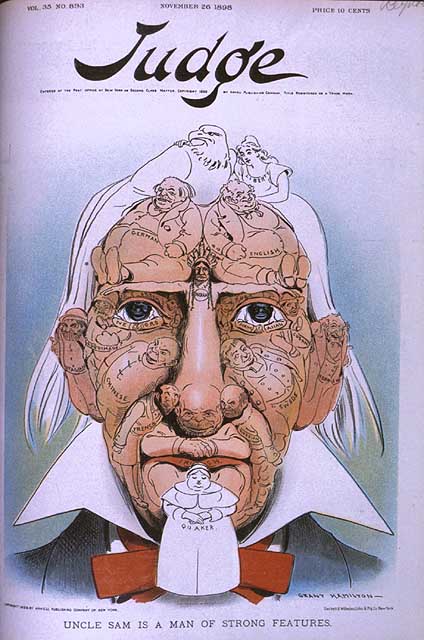
Uncle Sam - Strong Features

Uncle Sam - Strong Features
"Uncle Sam is a Man of Strong Features" (1898)

Monday, September 12, 2011

"Bread Givers" -Discussion Questions

-Throughout the course of the novel, how has Sara's vision of what a person should be change? Did Sara acquire the "American Dream" she desired? 

-Although Hugo Seelig tells Sara that they are of  "one blood," in what ways are they different and what role does Hugo play in mending both Sara's "old" and "new" worlds?  

-Why does Sara accept her father back into her life after the way he has treated her mother, sisters, and herself? 

-What is the significance of the shadow that follows Sara around in the end of the novel? 

-Was Sara successful in becoming an "American" or do you believe that Sara failed to become a person of the "new world"?

-Overall, what message is Yezierska trying to convey regarding an immigrant's internal struggle to find harmony between his or her "old" and "new" worlds? 

Discussion Questions for Book 3

1) At the end of the chapter, "Death in Hester Street", is Sara truly considered "cold hearted" in terms of being absent from her family?
2) How does the role of Sara's mother being subordinate to her husband take a toll in her death?
3) Could it be perhaps that Reb Smolinsky's second marriage backfired in regards to the marriages he set up for his daughters?
4) Is Sara satisfied for giving up love in the beginning to continue her education first?
5) In the end when Sara invites her father to live with her, how does this show that she has always been loyal to him even when she despised his tyranny?

Thursday, September 8, 2011

Does Yerzierska's The Bread Givers border on folklore?

Throughout my reading of The Bread Giver's I have found that the novel border's on the folktale or fable. There are several characteristics of the novel which I feel exemplify the novel's folkloric tendencies and thereby detract from it's realism. I am going to speak of just one. The use of the tragic in The Bread Givers.
The novel deals with many tragic happenings. They occur so frequently and with such intensity that they have a unreal quality. Often the tragedies bare the mark's of the author's craft. What I mean by this is that the tragedy seems placed by the author to create a new branch in the plot. The tragedies are obvious because of their unlikely circumstance and the narrators melodramatic treatment of the situation. One such tragedy is when the family is scammed in the chapter "father becomes a business man". This section illuminates the melodramatic treatment of the novels plot. Upon purchasing the business "tears of thankfulness" fill sara's mother's eyes as her happiness flies "higher and higher". Things have seemed to worked out for the family. However, from the prior structure of promise and tragedy seen in the marriage of the daughters we know it is not going to be true. In the strange passage in which sara knocks over the empty boxes.He mother upon upon realizing that they are empty holds the boxes with an expression on her face "as if she [was holding] something bewitched." This strange tragedy is expected by the reader because of the structure of constant promise and failure. This structure detracts from the novel's realism however it evokes the absurd and grim trials of western folktale and and seem especially akin to the trials of Job. It seems to me that when Yezierska departs from realism it is often in lieu of more archaic forms of storytelling such as the folktale or the fable.

Do you agree or disagree that some of the novel seem's folklorish?
Why or why not?

Wednesday, September 7, 2011

Bread Givers Discussion Questions (pgs 155-234)

1. What does Max Goldstein give to Sara that she has never had before?


2. How does the failed marriages of Sara's sisters explain to us the flaws of the"old world"?


3. Why is Sara constantly told she will become an "old maid"?


4. How does Aniza Yezierska successfully use symbolism and imagery to create the reality effect?

Tuesday, September 6, 2011

Some thoughts about today.

Thought #1: The experience of immigration during the time in which this novel takes place, was a tumultuous one at the very least. It was not a simple transition from one life to another, it was a complete upheaval of a former life in exchange for a chaotic, uncertain existence in the next. Sara's parents clinging with such fervor to the so-called "old world" in the face of the unfamiliarity and cruelty of the new, is a completely human response, one that I cannot vilify them for (no matter how easy her father makes it for me)

Thought #2: In our discussion today, we touched on how immigration can exacerbate the generation gap that exists between parents and their children. It seemed that the blame was and is placed on the battle between the parents who fight for the "old world" and their American born children who yearn for the "new". My contention, however, is that it is not the battle between the old and the new that isolates one generation from another, but the notion that a battle, that a choice, between old and new, is even necessary. The beauty of America (cue "Stars and Stripes Forever") is that you don't have to choose between the "old" and the "new", they can, and do, co-exist and if we (this is relevant to our generation too) were to rid ourselves of the desire to wage ideological war with one another, and realize how indispensable varied modes of thought are to the American identity, the chasm that divides us, would begin to close.

Monday, September 5, 2011

Bread Givers - Questions

  1. Why does the father refuse to work?
  2. What are some ways in which we see male superiority within the novel?
  3. What is the role of love in the novel?
  4. How does the first paragraph on page 52 foreshadow Sara's struggle towards independence?
  5. Which is more esteemed within the Jewish tenements- a wise Torah scholar or a rich man?
  6. Last paragraph on page 64- Food for thought: How should teachers/wise men/ or our elders teach without estranging the young?
  7. What emotions did you feel as you read pages 137 and 138 ? Elaborate.
  8. Why does Sara never directly blame G-d?
  9. Does the fact that Sara's the youngest impact her perception of her family ?
  10. Why does Mother describe her husband as a "stone giver" ? (Page 127)

Saturday, September 3, 2011

Class discussion questions

Questions to "Bread Givers"

1. Why do you think Yezierska tilted her novel that way?
2. What did shock or surprise you during reading the novel?
3. Have you noticed any cultural aspects that are new to you or are not part of the American culture?
4. Do you think that Smolinsky's family adopted to American norms?
5. What do you think about the way Yezierska portrayed the status of an immigrant woman?